- Last Updated Oct 19, 2026Published Date Oct 09, 2026
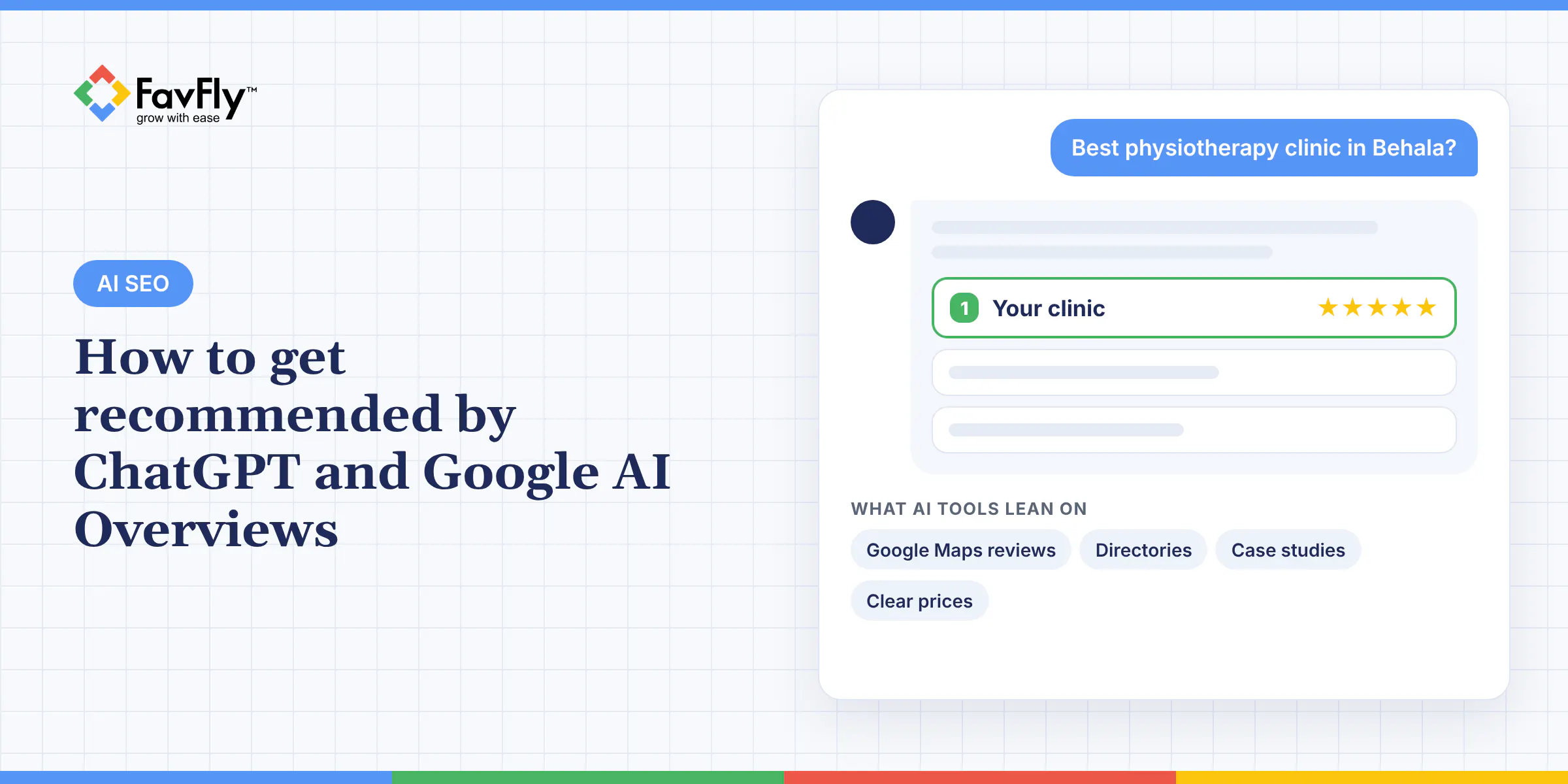
Picture someone in Behala with a stiff back after a week hunched over the office laptop. They don't Google anything. They open ChatGPT, type "Which is the best physiotherapy clinic near Behala?", read three names and WhatsApp the first one. Your website never got a look.
So how do you get recommended by ChatGPT? AI tools name the businesses they can find described the same way in lots of trusted places: your Google Business Profile and its reviews, directories, your own website, and what other people post about you. The ones that get named state their prices, results and location plainly, so the AI has facts to repeat. You can't buy your way into the answer. You can feed it better evidence, though.
Quick answer: ChatGPT and Google AI Overviews recommend businesses that show up consistently across Google Maps, reviews, directories and their own websites, starting with a complete Google Business Profile and pages that state prices and results in plain numbers. ChatGPT search pulls from its own index plus outside providers, so get indexed on Google and Bing and don't block OpenAI's crawler. Then test the same 10 buyer questions in ChatGPT, Gemini and Google every month.
Cited and recommended are two different things
Being cited means the AI links to your page as a source. Being recommended means it names your business as someone the buyer should call, and for a local business that's the one that makes the phone ring.
A citation is the little link chip sitting next to a sentence. Your blog post on modular kitchen costs can get cited all week without your company ever being suggested (which is mildly insulting, if you think about it). A recommendation reads more like "Here are three well-reviewed interior designers in Salt Lake: A, B and C", with your name in it and sometimes your star rating too.
We've covered the content side already, in how to get cited in AI search results and how GEO and SEO work together. This one is about what makes an AI tool comfortable putting your name in front of a buyer.
Is anyone really asking AI for local businesses?
Yes. BrightLocal's Local Consumer Review Survey 2026 found that among US consumers, use of ChatGPT and other generative AI tools for local recommendations went from 6% to 45% in a year, and 40% said they trust AI platforms to give business recommendations. India's numbers will be different. We'd be surprised if the habit stopped at the US border.
How does ChatGPT decide which businesses to recommend?
It looks for businesses that turn up again and again, with matching details, in sources it trusts. With search switched on, ChatGPT looks things up live and picks the names that appear in several places alongside reviews and specifics it can quote.
We wanted to see this for ourselves. On 19 October 2026 our team at FavFly asked ChatGPT 10 buyer questions about lead-generation agencies in Kolkata, the kind of thing an owner types at 11 pm after their current agency has gone silent again. The answers kept leaning on Google Maps listings and their reviews, on agency directories like GoodFirms, Semrush Agency Partners and DesignRush, and on agencies' own published case studies with numbers in them. The agencies whose sites stated prices, cost per lead and case-study figures were named most. Which is a little funny, because hiding prices behind a "contact us" button is practically an agency tradition.
And it lines up with how ChatGPT search gets its results. OpenAI only says it partners with other search providers. A September 2026 investigation by Peec found that ChatGPT now runs its own search index and still pulls from at least eight outside providers, including channels that return Google results, Microsoft's grounding service, and licensed local data from Yelp and TripAdvisor. So "ChatGPT just uses Bing" is out of date. Bing is one input among several.
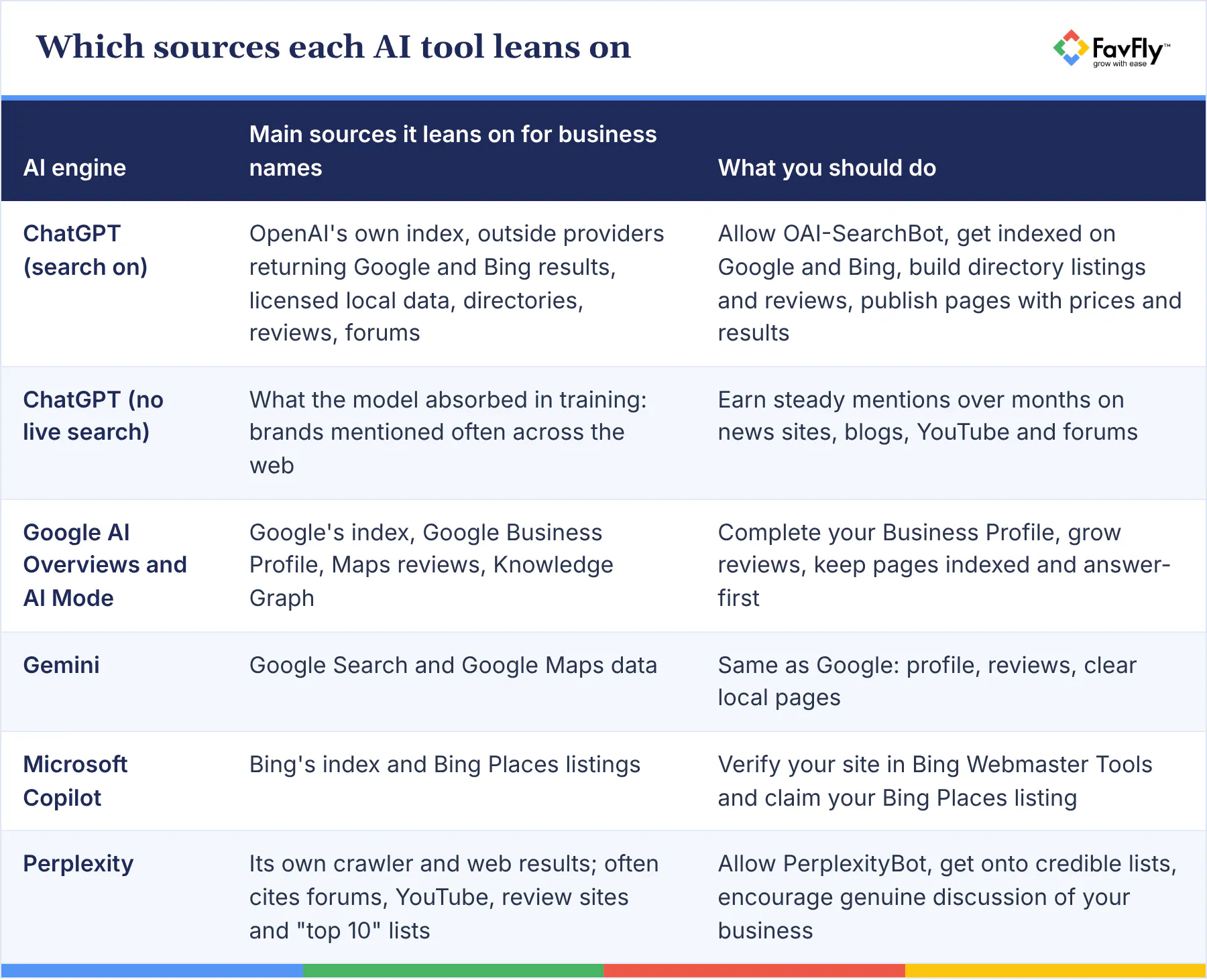
Which sources each AI tool leans on
Use this as a working guide. These systems change every few months, and what's true now may look different by Poila Baisakh.
How to get recommended by ChatGPT: fix these first
Every AI engine reads roughly the same signals, so this order works for all of them.
"Our Google profile has 22 reviews and an old phone number"
This is where most recommendations begin. Google's AI features read Google's business data directly, and in our Kolkata test ChatGPT was picking up Maps listings and reviews as well.
Go through your profile properly: category, service areas, hours, phone, WhatsApp link, photos, service descriptions. Then start on reviews, where both how many you have and what they say count. A review like "Dr. Sen fixed my root canal in one sitting, very gentle" tells an AI exactly what you're good at, and "nice clinic, good" tells it nothing. Our guide on how to get more Google reviews has scripts you can send straight on WhatsApp. If you'd rather hand the whole thing over, that's what our Google Business Profile SEO service does for clients.
"We're on Justdial, but the address there is from 2019"
AI tools trust facts that agree with each other. If Google says Sector V, Justdial says Sector II and Sulekha still lists that dead landline, the AI has every reason to doubt all three.
Pick the directories buyers in your trade really use. For agencies, that's GoodFirms, DesignRush, Clutch and Semrush Agency Partners; clinics want Practo and Google; manufacturers live on IndiaMART and TradeIndia. Then make the name, address and phone match exactly. Our post on NAP citations for local SEO walks through a full audit.
"We don't put prices on the website. Clients should call us."
We hear this every month, and it's costing you AI recommendations. Ask ChatGPT "how much does a wedding photographer in Kolkata charge" and it quotes whoever bothered to publish a number.
You don't need a rigid rate card, and ranges are fine. Something like "Most 2BHK modular kitchens we fit in New Town fall between ₹1.8 lakh and ₹3.5 lakh, depending on material" does the job. Add what's included, typical timelines and what moves the price. The enquiries get better qualified too, because people who were never going to spend ₹1.8 lakh drop off before they call.
"Our work is good, we've just never written it up"
Then write it up. Case studies with numbers are the closest thing an AI has to proof: "120 to 160 leads per month" can be quoted, and "great results for our client" can't. Keep each one plain. Who the client was (with permission), the problem, what you did, the numbers and the timeframe.
"Our blog is mostly Durga Puja greetings"
Nice for Facebook. AI tools want short, direct answers, so write one page per question your buyers ask (cost, how long it takes, what to check before hiring) and put the answer in the first two sentences. Our post on zero-click searches and featured snippets explains the format, and it works just as well for AI answers.
SEO for ChatGPT and AI Overviews: the technical checks
SEO for ChatGPT means AI crawlers can reach your pages, you're indexed on both Google and Bing, and your business facts are marked up clearly. If you're asking how to rank in ChatGPT, start with access. A blocked crawler cancels everything else in this post.
Can ChatGPT even see your website?
OpenAI's publishers and developers FAQ says any public website can appear in ChatGPT search as long as it doesn't block OAI-SearchBot. The catch is that some hosting firewalls and those cheerful "block AI bots" settings can block it without anybody noticing. Ask your developer to check robots.txt and the firewall rules.
A second crawler, GPTBot, is used for training. You can block it and still allow OAI-SearchBot, so you show up in search answers without your content going into training.
Bing (yes, Bing)
ChatGPT draws on outside search results and Copilot runs on Bing, so being missing from Bing is a real gap, even if nobody in your office has opened Bing on purpose in years. Verify your site in Bing Webmaster Tools, submit your sitemap and claim Bing Places. It can import your Google Business Profile.
And structured data?
A bit. Structured data is code that labels the facts on a page so machines can read them, and it helps AI tools match your website to your business. Add LocalBusiness schema with your name, address, phone, hours and sameAs links to your Google profile, social pages and directory listings. Google's own Search Central guidance says there's no special schema needed to appear in AI Overviews or AI Mode, and that markup has to match what's visible on the page. So schema makes your facts unambiguous. It can't rescue a thin page.
Getting your business mentioned in AI answers, off your own site
AI tools give more weight to what other people say about you than to what you say about yourself. That means you need genuine mentions on Reddit, Quora, YouTube, local news and industry sites.
Ahrefs studied 75,000 brands and found branded web mentions had the strongest correlation with AI Overview visibility, at 0.664, well ahead of backlinks at 0.218. Ahrefs itself points out that correlation isn't causation. Still, it fits our Kolkata test, where the answers leaned hard on third-party directories and listings.
Earning them without turning into a spammer takes patience. Answer questions on Quora and in threads like r/kolkata under your real name, and only where you can genuinely help (r/kolkata can smell a sales pitch from across the Hooghly). Put up short YouTube explainers with your business name and city in the title and description. Pitch local news and trade publications something useful, such as wedding season price trends. And get into association, chamber of commerce and partner listings, which are dull but count.
What about those packages that promise to drop your name onto hundreds of sites? Skip them. This one annoys us more than most. Those sites look like spam to buyers, and they add nothing an AI tool would trust.
Okay, so how do you know if any of this is working?
Ask the same buyer questions in each AI tool every month and write down whether you're named and which sources show up. A spreadsheet and 30 minutes will tell you plenty.
- Write 10 questions your buyers really ask, such as "best orthodontist in Gariahat", "affordable interior designer in Howrah" or "who makes fly ash bricks near Kolkata".
- Ask each one in ChatGPT (search on), Gemini, Google (check AI Overviews and AI Mode) and Perplexity, in a logged-out or fresh session.
- Record whether you're named, your position in the list, what the AI said about you, and which sources it showed.
- Note which competitors get named and which sources mention them. Those sources are your to-do list.
- Repeat on the same day each month and compare.
For hands-off tracking, tools like SE Ranking's AI Results Tracker monitor how often your brand is mentioned or linked in Google AI Overviews, AI Mode, Gemini and ChatGPT, next to your competitors. For Google, Search Console's Search Generative AI performance report (live for all sites since August 2026) shows how often your pages appeared in AI Overviews and AI Mode. And in Google Analytics, look for utm_source=chatgpt.com, which OpenAI says ChatGPT adds to referral links.
Answers vary by person and by day, so judge the trend over months and don't lose sleep over one bad Tuesday.
How we do this at FavFly
At FavFly we treat AI recommendations as what you get from strong local SEO plus clear proof, so we start with the Google profile and the facts on the website. For Smiley Dental Clinic, our Google Business Profile work tripled local engagement, and a busier, better-reviewed profile gives Google's AI features more to read about the clinic. For Bosky Interior, our website SEO put 100% of target keywords in Google's top 5 and brought 120 to 160 leads per month. That case study states its numbers plainly, which is exactly the format AI answers like to quote.
A hypothetical, then. Say you run a dental clinic in Salt Lake with 40 reviews and no prices on the website. In month one you fix the profile, send a WhatsApp review request after every appointment, and publish a "cost of dental implants in Kolkata" page with real ranges. Month two is for cleaning up Practo and Justdial and adding schema. By month three you're testing prompts and noting which sources keep mentioning the clinic down the road. Nobody can promise an AI will name you. Every one of those steps gives it more to go on.
Frequently asked questions
Can I pay ChatGPT to recommend my business?
No. ChatGPT does show ads to some free users in certain countries, but OpenAI says ads do not influence the answers ChatGPT gives you. The only way into the answer is being well represented where ChatGPT reads: your Google profile, reviews, directories, your website and genuine mentions elsewhere.
How long does it take to get recommended by ChatGPT?
In our experience, a local business starting from a weak base should expect three to six months of steady work before its name turns up regularly. Fixing listings and crawler access can show results within weeks when ChatGPT's search is on. Getting remembered by the model itself, with no search, takes longer because it depends on training updates.
Does ChatGPT use Google reviews?
Often, yes. Our October 2026 test with Kolkata buyer questions saw it lean on Google Maps listings and their reviews, and Peec found it pulls Google results through outside providers plus licensed review data from Yelp and TripAdvisor. Google reviews first, then whichever platforms your buyers use.
Is SEO for ChatGPT different from normal SEO?
Mostly it's the same foundation, with a few things turned up louder: Bing indexing, allowing OAI-SearchBot, mentions on forums and video, and pages that state prices and results in quotable sentences.
How do I check if ChatGPT recommends my business?
Turn search on, open a fresh session and ask what your buyers ask, like "best [service] in [area]" or "affordable [service] near [locality]". See if you're named and which sources it shows. Do it monthly. If that sounds tedious, SE Ranking's AI Results Tracker can automate it across several AI tools.
Do Google AI Overviews recommend local businesses?
For many local searches, yes. AI Overviews and AI Mode can name businesses and show ratings, drawing on Google Business Profile data, reviews and websites. Google says no special optimisation is needed beyond good SEO, which in plain terms means a complete profile, steady reviews and clear service pages.
Start feeding the AI better facts
AI tools can only recommend what they can find and trust. If your listings disagree with each other and your prices are hidden, ChatGPT will happily name the business down the road that made its facts easy to repeat.
So start small. This week, fix your Google profile and ask five happy customers for a review. Next week, write one honest pricing page, make yourself a cup of chai and run the 10-question test to see where you stand.
Want help getting your business named in AI answers? Book a free consultation with FavFly and we'll look at where your business stands today, or see how our SEO services in Kolkata cover local and AI search together.
Start Growing in Just 3 Simple Steps
We assess your goals, craft a tailored strategy, and finally implement it so you can confidently grow your business.
Book a free consultation



Join Our WhatsApp Channel
Join our privacy friendly whatsapp channel and stay up to date with the latest news, updates, and exclusive offers. Join our community today!
Get Free Access
Solutions ❇️
Popular Gigs 📈
Tools 🛠️
- Ads Budget Calculator
- UnifyleadsSoon
- ShareUsReviewSoon
- BrandItSoon
- GrowSoon
FavFly Solutions for Your Digital Growth:
SEO Services in Kolkata | Local SEO Company in Kolkata | Digital Marketing Company in Kolkata | Social Media Marketing Services in Kolkata | WebStudio Website Development | UGC Reels Creation Services | Google My Business for Gynecologists | Google My Business for Restaurants | Google My Business Guide | Google My Business for Dentists | Google My Business for Interior Designers | Google My Business for Doctors | How Google My Business Profile Works
* About Us : At FavFly, we redefine digital marketing by focusing on what truly matters: your growth. We don’t just offer services like SEO, SMM, and website development – we become an integral part of your success story, providing strategic guidance and innovative solutions that empower your business to reach new heights.