- Last Updated Oct 19, 2026Published Date Oct 19, 2026
It's 9:40 pm and your phone buzzes. A stranger on WhatsApp: "Price?" You reply at 11 the next morning, and by then they've booked the clinic two lanes away in Behala.
We see some version of this every month, and it's why so many lead generation strategies fail in India. The lead arrived on time. The reply didn't. The lead generation strategies that work best for small businesses here meet buyers where they already search and chat, which means Google Business Profile, Google Search Ads, Meta lead ads, click-to-WhatsApp ads and local SEO. But what turns those enquiries into sales is what happens after they land: a reply within minutes, a proper follow-up plan, and every lead tracked to an actual sale.
Below are the 12 strategies we use at FavFly for clinics, interior designers, coaching centres and manufacturers, with honest ₹ ranges and when each fits.
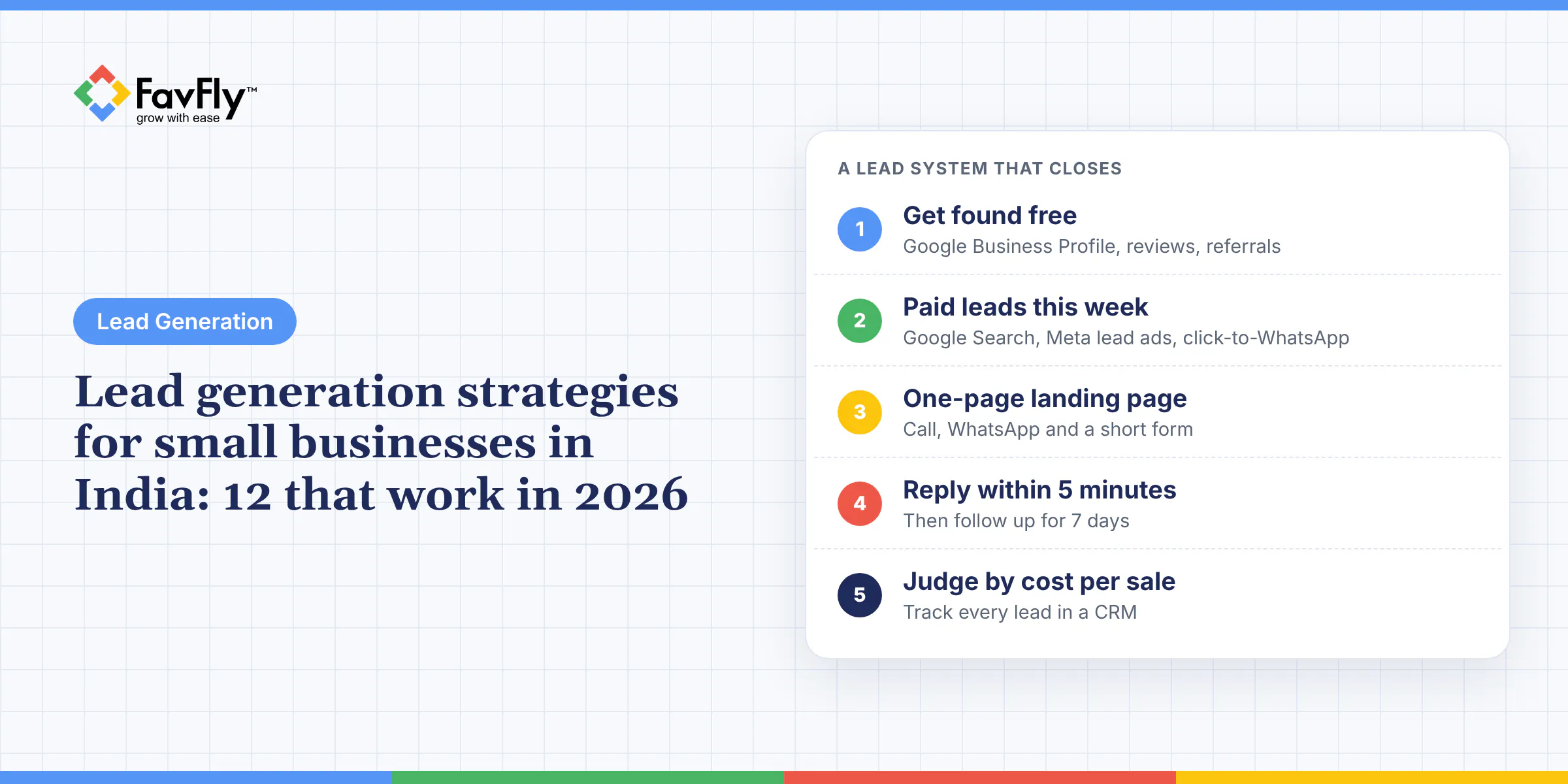
Quick answer: Start free, with a complete Google Business Profile, steady Google reviews and a referral system. For leads this week, run Google Search Ads (highest intent) or Meta lead ads and click-to-WhatsApp ads (cheaper, more volume, more filtering), pointed at a one-page landing page with call, WhatsApp and a short form. Then reply within 5 minutes, follow up for 7 days and judge every channel by cost per sale, which means tracking each lead in a CRM.
What is lead generation, and what works in India?
Lead generation is getting potential buyers to raise their hand (a call, a WhatsApp message, a form) so your team can turn them into paying customers. For most Indian small businesses, what works best sits closest to buying intent: people searching Google for your service, and people on Instagram who can tap one button to chat. Branding, content and email live in our guide to digital marketing strategies for small businesses.
The ₹ figures below are typical ranges we see in local campaigns across Kolkata and other Indian cities in 2026. Your category and offer will move them a lot.
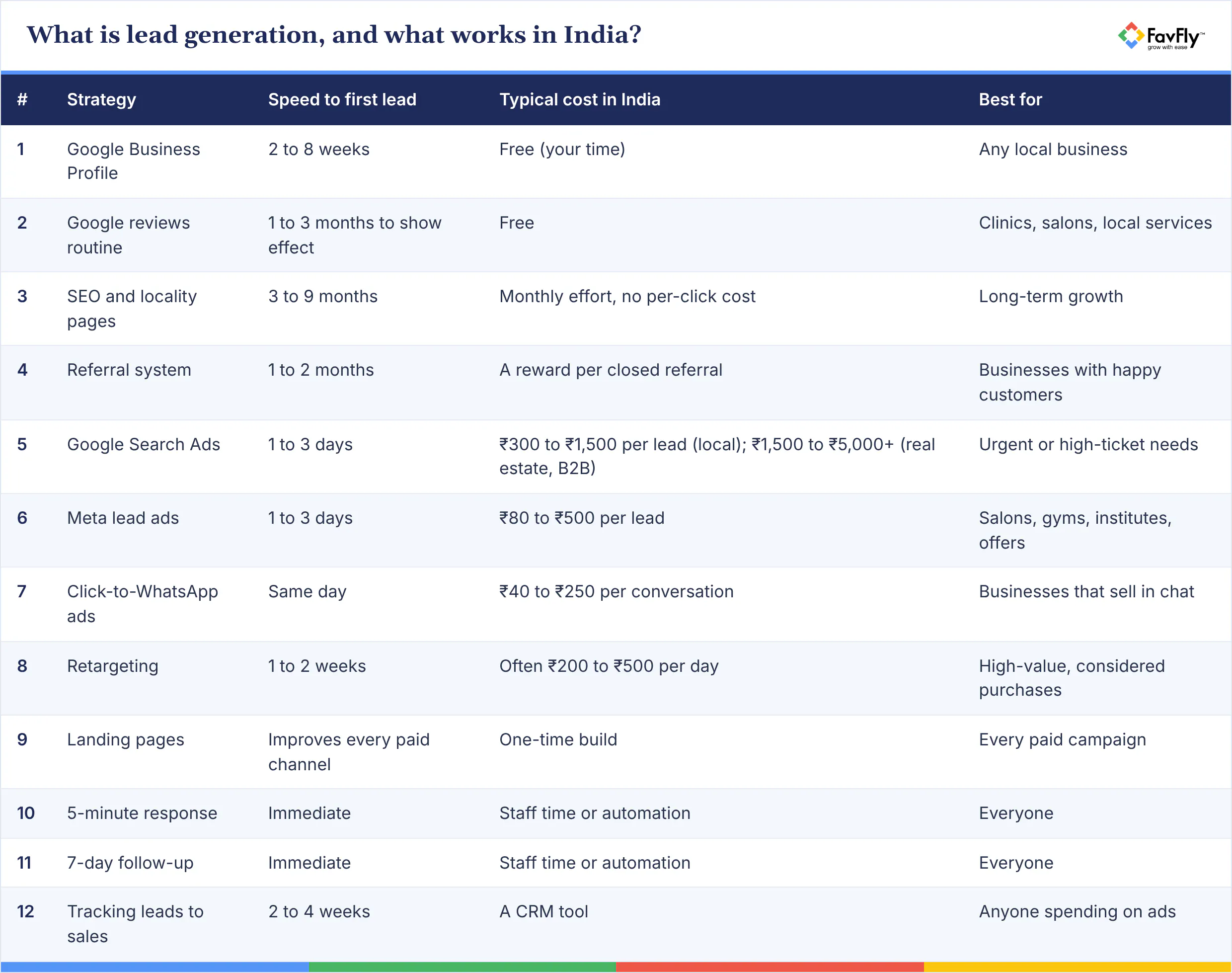
For a sensible monthly ad spend, try our free ads budget calculator.
The free stuff first (it mostly costs your time)
Tight budget? Start here. Google Business Profile, reviews, SEO and referrals are slower than ads, but each lead costs close to nothing.
1. "People search for us but find the shop next door"
Your Google Business Profile (GBP) is the listing that pops up on Google Maps when someone searches "interior designer in New Town" or "physiotherapist near me". It's often the cheapest source of calls a local business has.
Google says local results depend mainly on relevance, distance and prominence, and that there's no way to pay for a better local ranking. So you have to be the most complete, most active profile in your area, which means picking the most specific primary category you can ("Pediatric dentist" for a children's clinic), adding every service with prices where you can, uploading 20+ real photos, posting an update or offer every week and replying to every review, grumpy ones included. Or hand it to our Google Business Profile SEO service.
2. Reviews, or "we have 4.8 stars but only 11 of them"
Reviews decide who gets the call.
In BrightLocal's 2026 Local Consumer Review Survey of US consumers, 47% said they won't use a business with fewer than 20 reviews, and 74% only care about reviews from the last three months. That's American data. But in our experience buyers in Kolkata compare Maps listings the same way (be honest, would you pick the 4.8 with 11 reviews or the 4.6 with 300?).
Ask at the happy moment (the pain's gone, the kitchen's handed over) and send the review link on WhatsApp. If one in ten patients leaves a review, a clinic seeing 15 patients a day adds about 40 reviews a month.
3. "We only get leads when we run ads"
SEO (search engine optimisation) is the work of getting your website into Google's free results, and more and more into AI answers from Google AI Overviews, ChatGPT and Gemini. For leads, the pages that earn their keep are service and locality pages, like "modular kitchen designers in Howrah".
It's slow. Expect 3 to 9 months before SEO brings steady leads. Once a page ranks, though, each extra enquiry costs nothing, so we usually pair it with ads: the ads pay the bills now, and SEO brings your cost per lead down later.
4. Word of mouth, on purpose
If your best customers came through word of mouth, by luck, a referral system makes the luck happen more often. Ask right after a happy outcome, and make it specific: "Know anyone in your building planning a renovation?" beats "please refer us". Offer a service credit or voucher (many businesses set ₹500 to ₹2,000 per closed referral), hand over a ready-made WhatsApp message with your number in it, and thank people every time, even when the referral doesn't buy.
Which paid lead generation strategies work best for Indian small businesses?
Google Search Ads bring the highest-intent leads, because people are already looking for what you sell. Meta ads (Facebook and Instagram) bring cheaper leads in bigger numbers, since you reach people before they search, and so those leads need more filtering. Run one of each properly before adding anything else. Five channels run badly is the most expensive hobby we know of.
5. "We need calls this week"
Then it's Google Search Ads. They put you at the top of Google when someone types "skin specialist Salt Lake", you pay per click, and the buyer has already told you what they want. Bid on buying keywords ("near me", "price", "[service] in [area]") and add negatives like "free", "jobs" and "course". Add call assets so mobile users can ring you from the ad. Keep local campaigns to a tight radius; a clinic rarely needs more than 10 km. And track calls and form fills as conversions, or Google will happily chase clicks that never call.
Our Google Ads management team runs these for clinics, jewellers and photographers.
6. "Facebook leads are cheap but useless"
Meta lead ads use Instant Forms that open inside Facebook or Instagram, already filled in with the person's name and number. That's why they're cheap, and why some people submit without meaning it (a thumb slips, the form's done).
So put a little friction back. Switch the form type from "More volume" to "Higher intent", which adds a review step before submitting, and add one or two qualifying questions, such as budget or "When do you plan to start?" Then call within minutes, while they still remember filling your form.
7. "Nobody fills forms here, they just WhatsApp"
Click-to-WhatsApp ads are Facebook or Instagram ads that open a WhatsApp chat with your business when someone taps them. Meta's guide to ads that click to WhatsApp shows the setup in Ads Manager, where you choose WhatsApp as the messaging app.
They suit businesses that sell through conversation. Think of a jeweller sharing designs, or a coaching centre in Dum Dum answering fee questions at 10 pm. Set a greeting with 3 or 4 quick options ("Fees", "Timings", "Book a visit") and have a real person take over fast. This one annoys us: an automated hello followed by six hours of silence loses the lead, and you've already paid for it.
8. Retargeting the people who think about it and vanish
Retargeting shows ads to people who visited your website, watched your videos or messaged you but didn't buy. Nobody books a ₹4 lakh kitchen or a wedding shoot off one ad; it takes several touches. Show testimonials, before-and-after work and an offer to people who engaged in the last 30 to 90 days. Our guide to Meta retargeting covers the setup.
9. "Our ads send people to the homepage"
Please don't. Your homepage has a menu, an About Us page and probably a slider of the office inauguration. A paid visitor needs a page built for one action (call, chat or form) that ticks these boxes:
- ☐ A headline that repeats the ad's promise ("Root canal in Salt Lake, same-day appointments")
- ☐ Tap-to-call and WhatsApp buttons visible without scrolling
- ☐ A form with 3 or 4 fields at most
- ☐ Proof: your Google rating, real work photos, short testimonials
- ☐ "Starting from" prices, where your business allows it
- ☐ Fast loading on mobile data (test it on your phone with Wi-Fi off)
How do you stop losing leads you already paid for?
Reply within 5 minutes and follow up for at least a week. That's most of it. When we audit small businesses, the leak is usually after the lead arrives: someone replies late, calls once, and nobody writes down what happened.
10 and 11. Reply fast, then keep going past the first missed call
Harvard Business Review's The Short Life of Online Sales Leads reported an audit of 2,241 US companies. Just 37% replied to a web lead within an hour. 23% never replied at all. And the average response time? 42 hours. Yes, the study is from 2011 (the Stone Age, in internet years) and it's American, but we see the same pattern in India, and it's worst with leads that come in after 7 pm.
So, strategy 10. Every lead gets a reply within 5 minutes during working hours, and if you can't staff that, an instant WhatsApp goes out that confirms the enquiry and offers a call slot. Strategy 11 kicks in when they don't pick up:
- Within 5 minutes, call. No answer? Send a WhatsApp with your name and why you're calling.
- After 2 hours, call again.
- On the evening of day 1, send something useful, like a price range or photos of similar work.
- On day 3, call at a different time of day.
- On day 7, send a polite final message asking whether to close the enquiry for now.
Then tag each lead: interested, not reachable, not a fit, price issue, booked. Dull, we know.
How do you know which lead generation strategy brings sales?
Track every lead from where it came from to the final bill. Cost per lead is what an enquiry costs you. Cost per sale is what a customer costs you, and that's the one that should decide where your next ₹10,000 goes.
12. "Meta gives us 200 leads and Google gives us 40. Which is better?"
Say you run an interiors studio in Salt Lake and spend ₹30,000 a month on each. Meta brings 200 leads at ₹150 each and Google brings 40 at ₹750. Meta looks five times cheaper, and it's tempting to stop reading right there. Then you check sales. Six Meta leads bought, which is ₹5,000 per customer. Eight Google leads bought, which is ₹3,750 per customer. On cost per customer, Google comes out ahead.
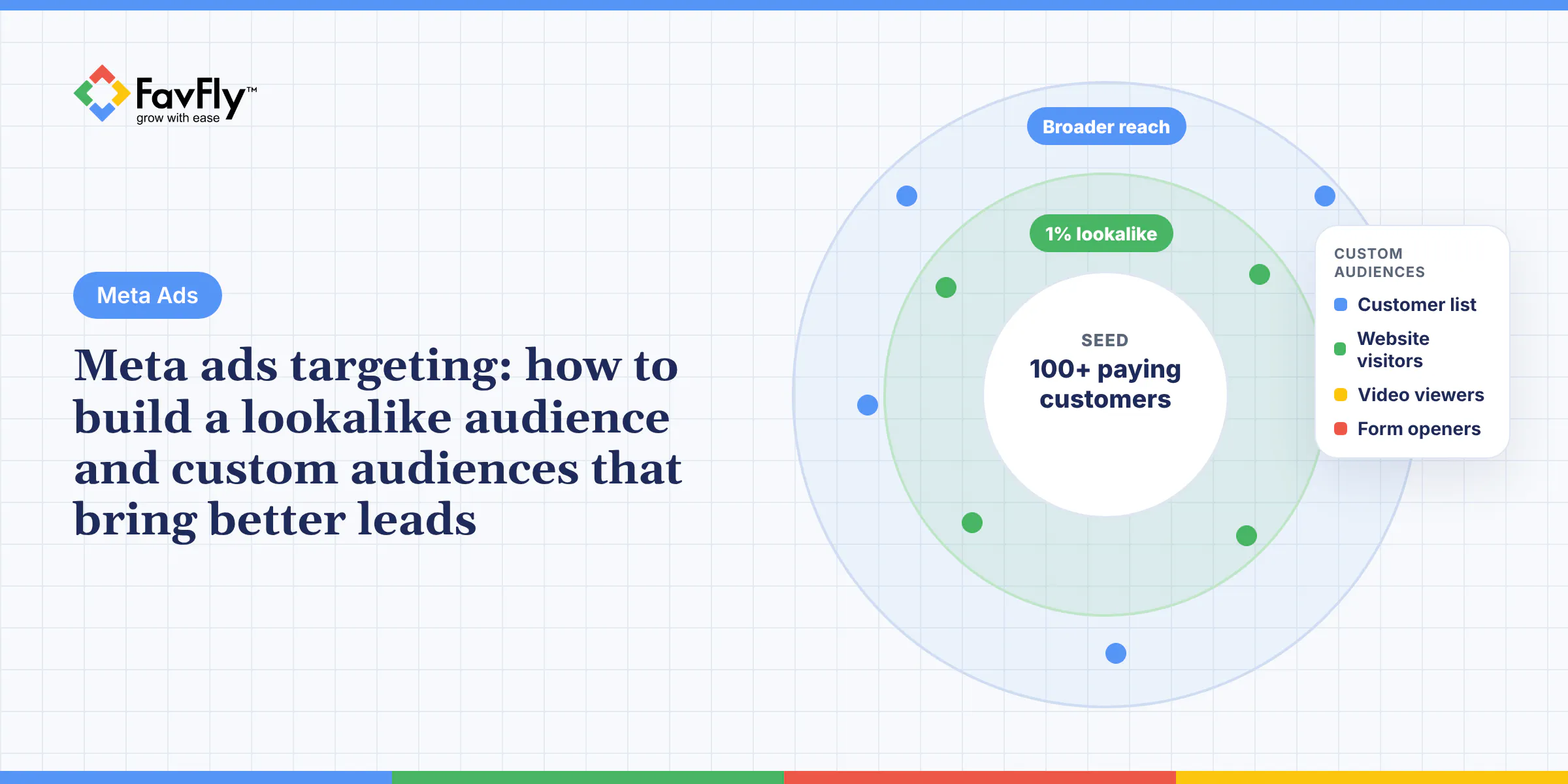
You only see this if every lead sits in a CRM (customer relationship management tool) with its source and outcome. Then send those outcomes back. Meta's Conversions API for CRM and Google Ads offline conversion imports tell the algorithms which leads became sales, so they go looking for more people like your real buyers.
How we do this at FavFly
At FavFly we build lead generation as one system: the channel, fast WhatsApp and call follow-up, and UnifyLeads, our lead tracking CRM, which puts leads from every source in one dashboard so you can see which campaign brought the sale. Our Lead10X lead generation programme packages that setup.
From our portfolio: a hyper-local 10 km Google Ads campaign for Rehabana brought 436 direct patient calls, and The Hybreed Gym got 59 leads in 7 days from a Facebook campaign. Bosky Interior got 100% of its target keywords into Google's top 5 and 120 to 160 leads per month. DSRV, a tax consultancy, got more leads from its Google Business Profile without Google Ads. And Swarnabha Industries has 3,080+ leads from Meta Ads.
Okay, so where do you start?
With whatever fits your budget and how fast you need leads. Under ₹15,000 a month on ads, fix your Google Business Profile, start a review routine and run one Meta lead ad or click-to-WhatsApp campaign. Between ₹15,000 and ₹50,000 a month, add Google Search Ads on your 10 to 20 best buying keywords, with a landing page. Above ₹50,000 a month, add retargeting, start SEO on service and locality pages and connect your CRM to Meta and Google.
The 5-minute reply rule and the 7-day follow-up apply at every budget, from day one.
Frequently asked questions
How do I generate leads for my business with no budget?
Google Business Profile first: every field filled, real photos, weekly posts, a reply to every review. Then a review habit, a referral system with a small reward per closed referral, and a WhatsApp button on your website and Instagram bio. It mostly costs your time.
What is a good cost per lead in India?
Honestly, it depends on what you sell and where. Our rough numbers for local service businesses: ₹80 to ₹500 a lead on Meta lead ads, ₹300 to ₹1,500 on Google Search Ads. Real estate, B2B and education? Often ₹1,500 to ₹5,000, sometimes more. If the cost per sale still leaves you a profit, it's a good number.
Which is better for lead generation, Google Ads or Meta Ads?
Google catches people already searching, so leads cost more but are closer to buying. Meta reaches people earlier, so leads are cheaper but need filtering and faster follow-up. Many Indian small businesses use Google for urgent or high-ticket enquiries and Meta for volume and WhatsApp chats.
How quickly should I follow up on a new lead?
Five minutes. If nobody's free to call, let an automatic WhatsApp go out first so they know you're alive. Remember that HBR audit of 2,241 US companies, with its 42-hour average reply and 23% who never replied? The bar is on the floor.
Does a small business need a CRM for lead generation?
Once you're past about 50 leads a month, or running ads on more than one platform, yes. Otherwise nobody's writing down where each lead came from, who called them back or whether they bought, so you end up comparing cost per lead, and that number on its own often sends money to the wrong channel. Under 50 a month? A shared spreadsheet does the job.
Pick one channel and make it work
You don't need all 12 this month. Pick one or two that fit your budget, add the 5-minute reply and the week of follow-up, and track every lead to the bill. Within 60 to 90 days you'll know your real cost per customer, and after that growth is mostly arithmetic. The busiest clinics in Salt Lake tend to do two things well. They answer first, and they keep count.
Want help building a lead system that brings calls and WhatsApp enquiries that close? Book a free consultation with FavFly or see how our Lead10X programme works.
Start Growing in Just 3 Simple Steps
We assess your goals, craft a tailored strategy, and finally implement it so you can confidently grow your business.
Book a free consultation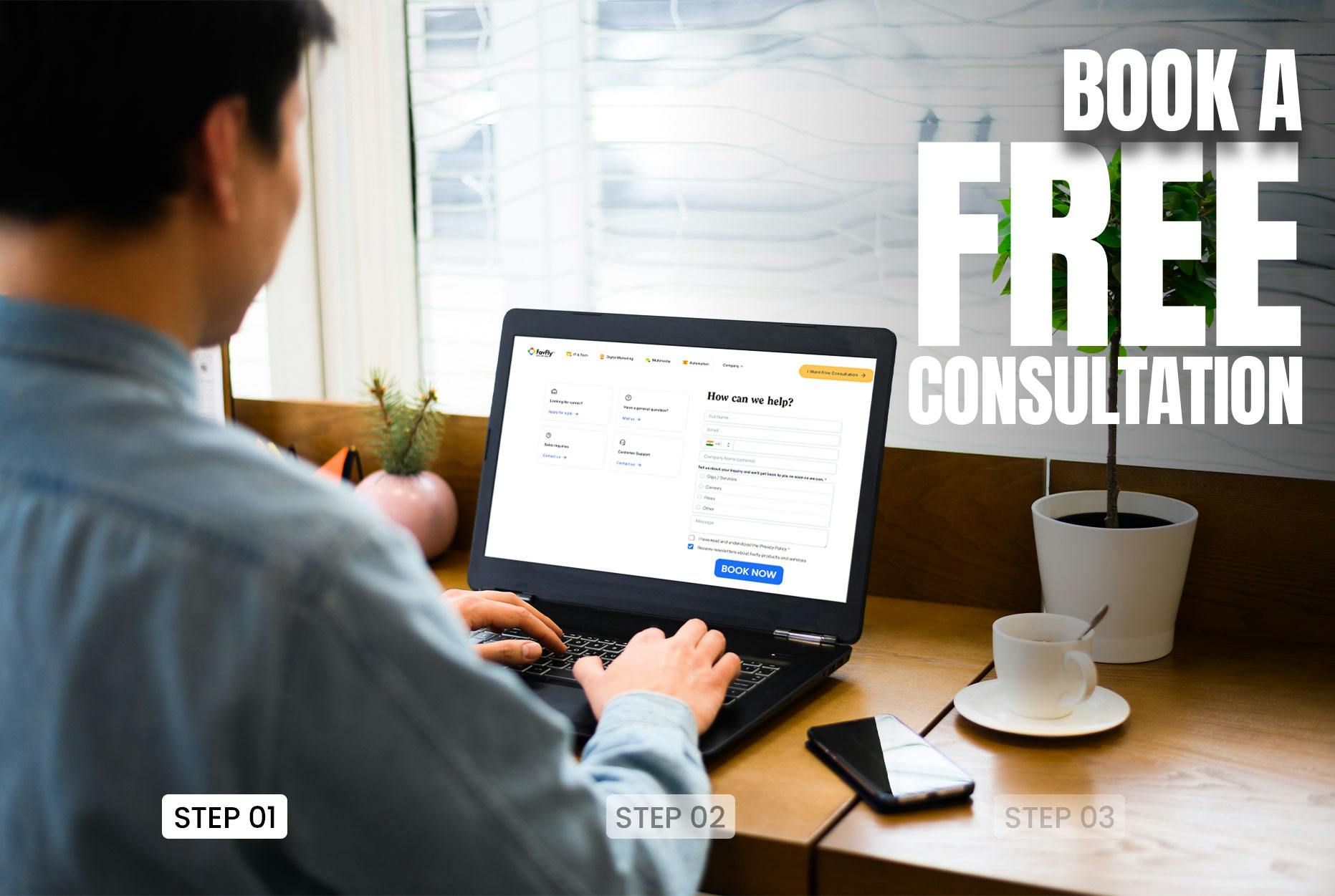

Join Our WhatsApp Channel
Join our privacy friendly whatsapp channel and stay up to date with the latest news, updates, and exclusive offers. Join our community today!
Get Free Access
Solutions ❇️
Popular Gigs 📈
Tools 🛠️
- Ads Budget Calculator
- UnifyleadsSoon
- ShareUsReviewSoon
- BrandItSoon
- GrowSoon
FavFly Solutions for Your Digital Growth:
SEO Services in Kolkata | Local SEO Company in Kolkata | Digital Marketing Company in Kolkata | Social Media Marketing Services in Kolkata | WebStudio Website Development | UGC Reels Creation Services | Google My Business for Gynecologists | Google My Business for Restaurants | Google My Business Guide | Google My Business for Dentists | Google My Business for Interior Designers | Google My Business for Doctors | How Google My Business Profile Works
* About Us : At FavFly, we redefine digital marketing by focusing on what truly matters: your growth. We don’t just offer services like SEO, SMM, and website development – we become an integral part of your success story, providing strategic guidance and innovative solutions that empower your business to reach new heights.