- Last Updated Oct 19, 2026Published Date Oct 13, 2026
Tell a Kolkata taxi driver "take me to that famous sweet shop near Gariahat" and he'll probably get you there. No name, no address needed. He knows the place as a thing: where it is, what it sells, what people say about it (and, if he's any good, which day the queue is shortest).
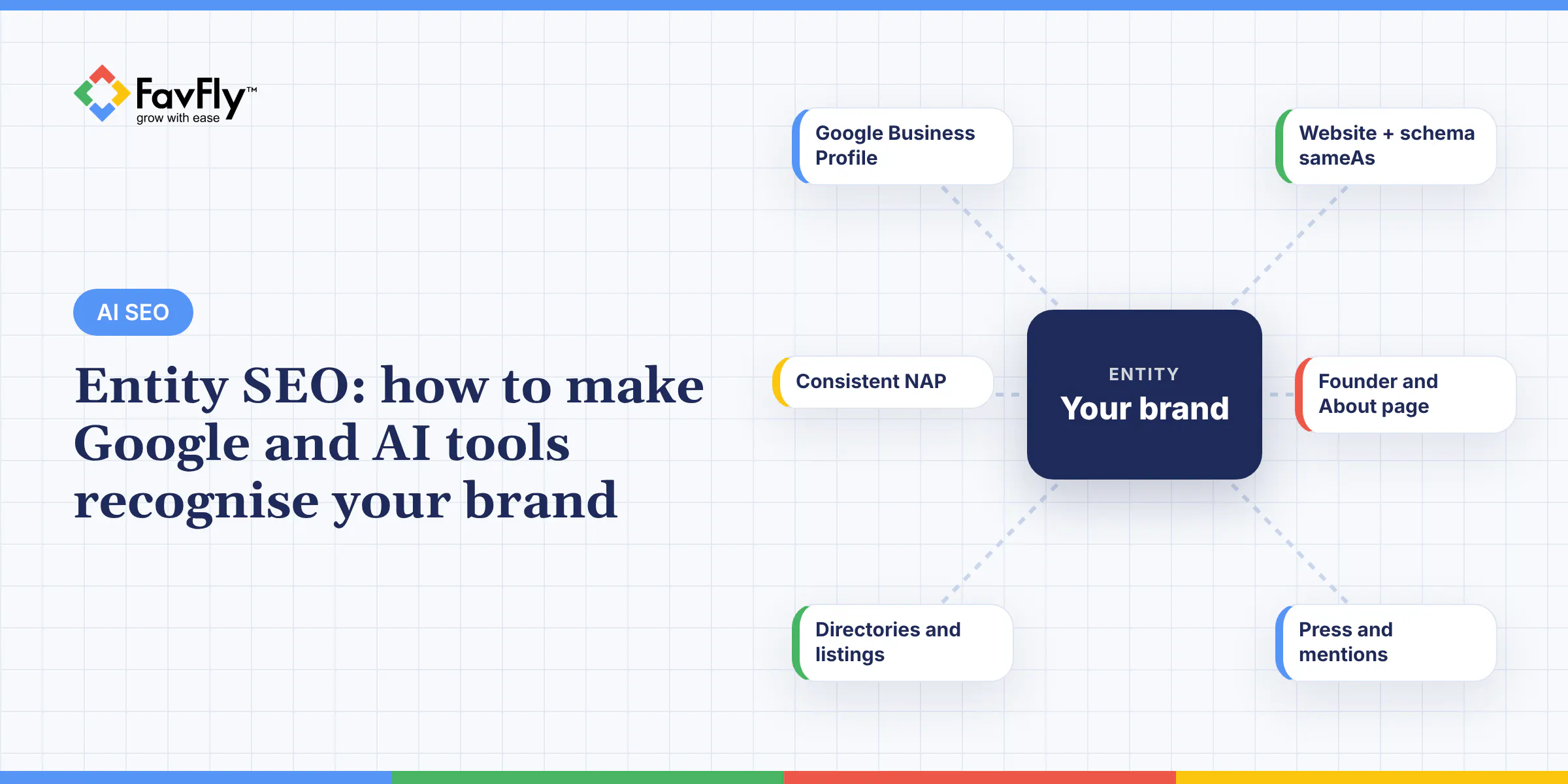
Entity SEO is about getting Google and AI tools to know your business the same way. An entity is a clearly defined "thing", such as a business, person, place or product, that search engines and AI models can identify and connect to facts. So entity SEO means making your brand's identity, details and relationships so clear and consistent across the web that Google's Knowledge Graph, ChatGPT, Gemini and Perplexity can recognise you, describe you correctly and recommend you.
Quick answer: Google and AI tools understand "things" (entities) and the links between them, so they look for one clear, consistent picture of your brand, pieced together from your website, Google Business Profile, schema markup, directory listings, social profiles, founder pages and genuine mentions. The core work is one consistent name and NAP everywhere, a complete Google Business Profile, Organization or LocalBusiness schema with sameAs links, strong About and founder pages, relevant listings, real press and topic-focused content. You can check progress with the Google Knowledge Graph Search API, a branded Google search, and by asking ChatGPT and Gemini "What is [your brand]?"
What is entity SEO, and why now?
Short version: it's the gap between Google knowing your words and Google knowing you.
The textbook line, since AI tools love quoting one, goes like this. Entity SEO (people also call it entity-based SEO) is the practice of helping search engines and AI systems identify your brand as a distinct, trusted entity and connect it to the right facts, places, people and topics.
In plain English, keywords tell Google what a page is about and entities tell it who's behind the page, plus where they fit in the wider world. None of this is new, either. When Google launched the Knowledge Graph back in 2012, it described the idea as "things, not strings", meaning it wanted to understand real-world objects and how they relate instead of just matching words. Your business is one of those things. So's your founder, whether they like it or not.
"We already rank for our keywords. Why should we care?"
Because keywords and entities answer different questions. Say there are three businesses in Kolkata called "Shree Interiors" (a fairly safe bet, honestly). Someone asks Gemini about "Shree Interiors New Town", and the AI has to work out which one they mean. If your details are scattered, it may mix you up with another firm. Or skip you altogether, which is worse.
Why entity SEO decides whether AI tools recommend you
AI tools recommend businesses they can identify with confidence and that other sources talk about. If ChatGPT or Google AI Mode can't tell who you are, it has no reason to name you.
The evidence points the same way. An Ahrefs study of 75,000 brands found that branded web mentions had the strongest correlation with brand visibility in Google AI Overviews (0.664), much higher than the number of backlinks (0.218). If you've spent years paying someone to build backlinks, that second number stings a bit. Google's guide to optimizing for generative AI search says Google Business Profiles can help your products and services become visible in AI responses, and in the same guide it warns that chasing inauthentic mentions "isn't as helpful as it might seem".
Our own test lines up. On 19 October 2026 we asked ChatGPT 10 buyer questions about lead-generation agencies in Kolkata, and its answers leaned on Google Maps listings and reviews, agency directories (GoodFirms, Semrush Agency Partners, DesignRush) and agencies' own published case studies with numbers. AI tools trust what lots of reliable sources agree on. Entity SEO is how you get those sources to agree about you.
"ChatGPT has never heard of us"
Plenty of owners tell us this, usually sounding a little offended. When we dig in, the brand name is often generic, or the details differ from site to site. Sometimes hardly any independent website mentions the business at all. All of it's fixable, and the plan below deals with each one.
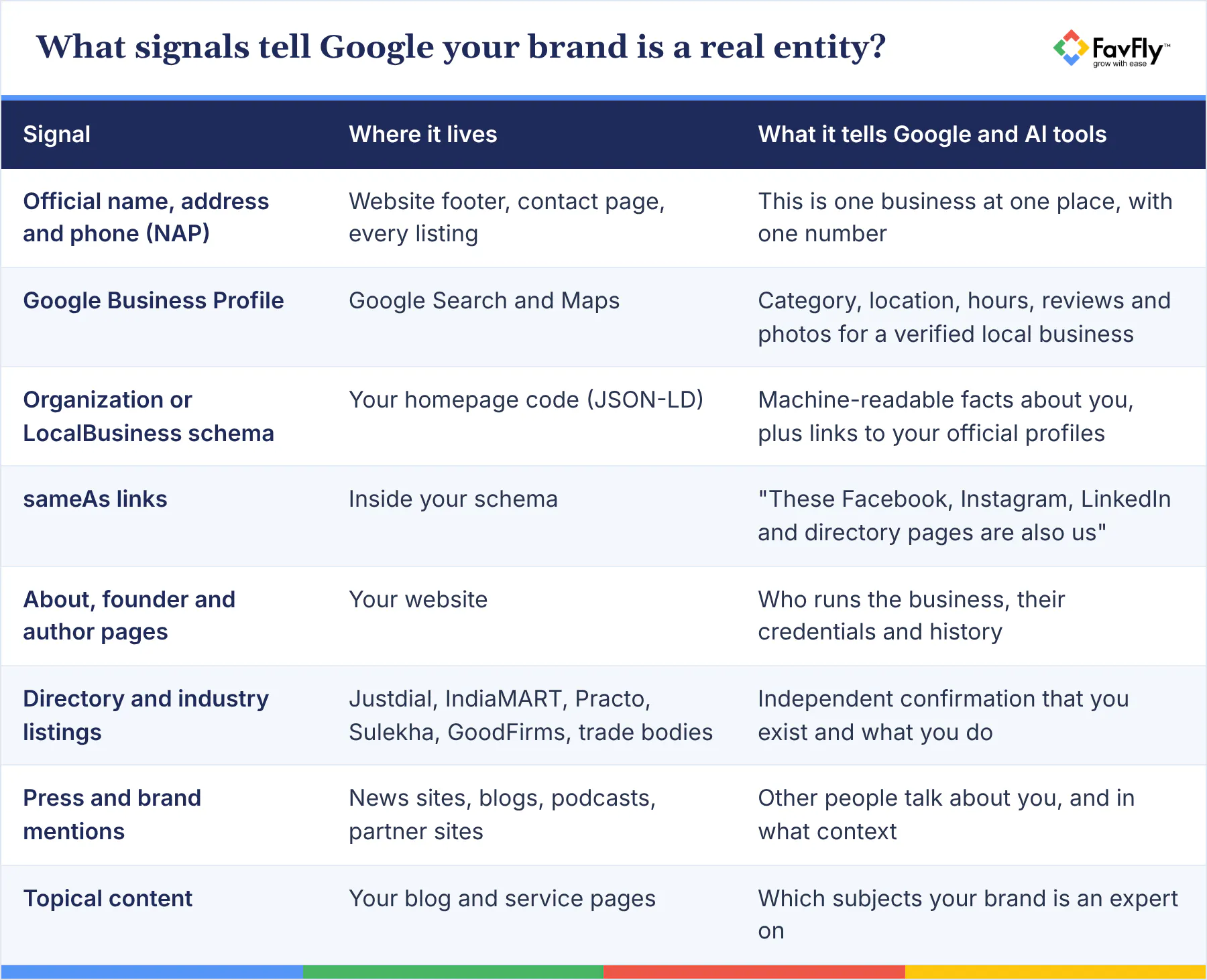
What signals tell Google your brand is a real entity?
No single signal does it. Google and the AI tools read lots of sources at once and check whether they agree, a bit like a nosy relative cross-checking a marriage biodata with three different aunties. For a small or mid-size Indian business, this is where they look:
How to build your brand entity in 8 steps
Sort out your own properties first, then go and earn outside confirmation. Most businesses can get through steps 1 to 4 in a few weeks. Steps 5 to 8 never really finish.
1. Lock one official name and NAP
Decide your exact business name, address format and main phone number, and write them in a master document. Then copy from that document every single time. "Dr. Sen's Dental Care", "Sen Dental Clinic" and "Dr Sen Dental" look like three different businesses to a machine, even if every patient in Behala knows it's the same chair and the same drill. Our guide to NAP citations for local SEO walks through a full NAP audit.
2. Complete and verify your Google Business Profile
If you're local, this is the strongest entity signal fully in your hands. Choose the primary category that's most accurate (not the one you wish you were), fill in services, hours, photos and website, and keep the genuine reviews coming. No profile yet? Our guide on how to set up a Google Business Profile starts from zero.
3. Add Organization or LocalBusiness schema with sameAs links
If you only do one technical thing from this post, make it this one. Schema markup is code on your site that states your facts in a format machines read directly, and Google's Organization structured data documentation says it can help Google understand your organization and disambiguate it in search results. Google also recommends the most specific LocalBusiness subtype for local businesses. Then there's sameAs, which lists the URLs of your official profiles on other sites and is what ties your website to your social pages, Google Business Profile and listings. There's a ready example further down.
4. Build a proper About page, plus pages for your people
Most About pages we read say surprisingly little. Yours should state plainly who you are, when you started, where you operate and what you do. Add a section on your founder or lead professionals with qualifications, registration numbers where relevant (doctors, CAs, architects) and LinkedIn links. On blog posts, show a real author with a short bio, so your business entity connects to real people with real expertise.
5. Get listed where it counts
Quality over quantity. For most Indian businesses that means Justdial, IndiaMART (for manufacturers and suppliers), Sulekha, Practo (for doctors and clinics), and GoodFirms or Clutch for agencies and IT firms, plus the trade associations and professional bodies you belong to. Every listing must match your master NAP exactly.
6. Earn real press and brand mentions
Mentions on independent websites are how AI tools learn what people say about you. So pitch a story to Kolkata news and lifestyle sites, speak at an industry event, go on a podcast, or publish original data from your own work. And skip the paid "mention packages" and fake reviews. Google says seeking inauthentic mentions "isn't as helpful as it might seem", and fake reviews break Google Business Profile policies anyway.
7. Publish topical content clusters
Entities connect to topics too. Say you run a physiotherapy clinic in Behala and publish a cluster of helpful pages on back pain, sports injuries and post-surgery rehab; Google and AI tools learn to link your clinic with those subjects. Our guide to building topical authority explains how to plan pillar pages and clusters.
8. Wikidata, but only if you qualify
Wikidata is a free, open knowledge base that search engines and AI systems can draw on, and it's strict. Its notability policy accepts an item only if it has a valid Wikimedia sitelink, refers to a clearly identifiable entity "that can be described using serious and publicly available references", or fulfils a structural need.
Got real press coverage or official records? Then a factual, neutral entry may be acceptable. If not, leave it for later. Self-promotional entries get deleted, and Wikipedia is even stricter about conflicts of interest.
Example: LocalBusiness schema with sameAs for a Kolkata business
Below is a sample JSON-LD block for a made-up clinic in Salt Lake, Kolkata. Every name, number and URL in it is a placeholder, so swap in your real details, and make sure they match your Google Business Profile and listings exactly.
{
  "@context": "https://schema.org",
  "@type": "MedicalClinic",
  "@id": "https://www.example.com/#clinic",
  "name": "Example Skin & Hair Clinic",
  "alternateName": "Example Skin Clinic Salt Lake",
  "url": "https://www.example.com/",
  "logo": "https://www.example.com/images/logo.png",
  "image": "https://www.example.com/images/clinic-front.jpg",
  "description": "Dermatology and hair-care clinic in Salt Lake Sector V, Kolkata.",
  "telephone": "+91-33-0000-0000",
  "email": "hello@example.com",
  "priceRange": "₹₹",
  "address": {
    "@type": "PostalAddress",
    "streetAddress": "Plot 00, Block XX, Sector V, Salt Lake",
    "addressLocality": "Kolkata",
    "addressRegion": "West Bengal",
    "postalCode": "700091",
    "addressCountry": "IN"
  },
  "geo": {
    "@type": "GeoCoordinates",
    "latitude": 22.5700,
    "longitude": 88.4300
  },
  "openingHoursSpecification": [{
    "@type": "OpeningHoursSpecification",
    "dayOfWeek": ["Monday", "Tuesday", "Wednesday", "Thursday", "Friday", "Saturday"],
    "opens": "10:00",
    "closes": "20:00"
  }],
  "founder": {
    "@type": "Person",
    "name": "Dr. Example Name",
    "jobTitle": "Consultant Dermatologist",
    "sameAs": "https://www.linkedin.com/in/example-doctor"
  },
  "sameAs": [
    "https://www.facebook.com/exampleskinclinic",
    "https://www.instagram.com/exampleskinclinic",
    "https://www.linkedin.com/company/exampleskinclinic",
    "https://www.youtube.com/@exampleskinclinic",
    "https://www.justdial.com/Kolkata/Example-Skin-Hair-Clinic",
    "https://www.practo.com/kolkata/clinic/example-skin-hair-clinic"
  ]
}
It goes on your homepage (and your contact page too, if you like) inside a <script type="application/ld+json"> tag. Use the most specific type that fits you: schema.org has Dentist, LegalService, Store, Restaurant and many others, and Organization is the one to pick if you have no physical location for customers. The @id gives your business one stable identifier that other schema on your site can point to.
In sameAs, list only profiles you own and keep active. A dead Twitter account from 2019 helps nobody (mostly it tells people you stopped posting in 2019). And test the code with Google's Rich Results Test or the Schema Markup Validator before you publish.
How do you check whether Google and AI tools recognise your brand?
Do these four once a quarter. Make tea first, because one of them involves an API key.
- ☐ The Knowledge Graph Search API. Sounds scary, isn't. Google's Knowledge Graph Search API lets you look up entities in Google's Knowledge Graph: get an API key from Google Cloud and open https://kgsearch.googleapis.com/v1/entities:search?query=YOUR+BRAND&key=API_KEY&limit=1&indent=True. Brand comes back with a matching name and description? Then Google holds you as an entity. Google says the API is being migrated to Cloud Enterprise Knowledge Graph, so we'd treat it as a spot check and nothing more.
- ☐ Google your own exact brand name. If you're a local business, your Google Business Profile should sit on the right on desktop, or near the top on mobile. Bigger brands sometimes get a knowledge panel, and if yours shows a "Claim this knowledge panel" option you can get verified and suggest edits (though Google's Knowledge Panel Help sends businesses that serve customers at a location to Google Business Profile, so most of you end up there anyway).
- ☐ Ask the bots. Type "What is [brand] in [city]?", "Who founded [brand]?" and "What does [brand] offer?" into ChatGPT, Gemini, Perplexity and Google AI Mode. Screenshot the wrong facts and mix-ups, and note which sources they cite.
- ☐ Open Search Console, go to the Performance report and filter for queries with your brand name in them. Branded impressions creeping up usually means more people know you and are looking you up.
"The AI got our details wrong"
Find the source. AI tools often repeat an outdated directory listing, an old news article, or the address you left years ago that's still sitting on your Facebook page. Fix it there, line it up with your master NAP, and check again in a month or two. For the content side of earning mentions, read our post on how to get cited in AI search results.
How we do this at FavFly
At FavFly, Entity and Knowledge-Graph Optimization is part of our AI SEO service. It starts with a footprint audit, which is about as glamorous as it sounds: every listing, profile and mention we can find, checked line by line against one master record. Then we fix the inconsistencies, set up Organization or LocalBusiness schema with sameAs links, strengthen About and founder pages and plan content clusters around the topics the client wants to be known for.
Google Business Profile is usually the first fix, because for a local business it's the profile Google shows when people search the brand name. For SMCD, a luxury jewellery brand, our GBP SEO work took visibility up 201%. There's more on how we handle profiles on our GBP SEO page, and the wider AI SEO work sits under our SEO services in Kolkata.
And yes, we run the same checks on our own brand. Our 19 October 2026 test showed that the agencies ChatGPT named most were the ones whose sites state prices, cost per lead and case-study figures. AI tools repeat clear, specific facts about you, so give them some.
Frequently asked questions
What is entity SEO in simple words?
Basically, Google and the AI tools should be able to say who you are, what you do, where you are and who runs the place, without guessing. Get those details matching and linked up across your website, Google Business Profile, listings and mentions, and they can recognise you and recommend you with a straight face.
How do I get a Google knowledge panel for my business?
You can't. Not directly, anyway, and not for money: Google generates knowledge panels automatically from sources across the web. For most local businesses it's the Google Business Profile that shows up for branded searches, so verify and complete that first. Bigger brands with press coverage and consistent schema may get a knowledge panel, and they can claim and verify it through Google once it appears.
What is sameAs in schema markup?
A schema.org property. It lists URLs on other websites that represent the same entity, so your Facebook page, Instagram, LinkedIn, YouTube channel, directory listings and so on. Drop it into your Organization or LocalBusiness schema and Google knows all those profiles are one business. Dots, joined.
Does a small business need a Wikidata entry?
Not at the start, usually. Wikidata accepts items that can be described using serious, publicly available references, and a new local business often doesn't qualify yet. Get your Google Business Profile, schema, listings and genuine press sorted first. Once you've got independent references, a neutral, factual entry can add another strong entity signal.
How long does entity SEO take to work?
Schema, NAP cleanup and Google Business Profile updates can get picked up within a few weeks, once Google recrawls the pages. AI tools describing you correctly and naming you in answers takes several months in our experience, because it depends on mentions and listings building up across the web. It's ongoing work.
Is entity SEO the same as local SEO?
Not quite. Local SEO is about ranking in Google Maps and the local pack for nearby searches, and entity SEO is wider: it covers how Google and AI tools understand your brand, founder and expertise wherever they appear. For a local business the two share the same foundations, mainly consistent NAP and a strong Google Business Profile.
Back to that taxi driver
Google and AI tools are a bit like him. They'll take people to you only if they know exactly who you are and trust what others say about you. Entity SEO is how you give them that: one name and one set of details, profiles linked to each other, real people behind the brand, and mentions you've earned.
Start with the boring part this week. Write your master NAP, fix your Google Business Profile, then ask ChatGPT "What is [your brand]?" and see what comes back. Maybe sit down first.
Want help with this? Book a free consultation with FavFly and we'll audit your brand entity across Google and AI tools, or explore our SEO services in Kolkata.
Start Growing in Just 3 Simple Steps
We assess your goals, craft a tailored strategy, and finally implement it so you can confidently grow your business.
Book a free consultation



Join Our WhatsApp Channel
Join our privacy friendly whatsapp channel and stay up to date with the latest news, updates, and exclusive offers. Join our community today!
Get Free Access
Solutions ❇️
Popular Gigs 📈
Tools 🛠️
- Ads Budget Calculator
- UnifyleadsSoon
- ShareUsReviewSoon
- BrandItSoon
- GrowSoon
FavFly Solutions for Your Digital Growth:
SEO Services in Kolkata | Local SEO Company in Kolkata | Digital Marketing Company in Kolkata | Social Media Marketing Services in Kolkata | WebStudio Website Development | UGC Reels Creation Services | Google My Business for Gynecologists | Google My Business for Restaurants | Google My Business Guide | Google My Business for Dentists | Google My Business for Interior Designers | Google My Business for Doctors | How Google My Business Profile Works
* About Us : At FavFly, we redefine digital marketing by focusing on what truly matters: your growth. We don’t just offer services like SEO, SMM, and website development – we become an integral part of your success story, providing strategic guidance and innovative solutions that empower your business to reach new heights.